It is used in a wide range of fields such as organic EL, LED, semiconductors, solar cells, and biotechnology!
We would like to introduce our "Characterization through Spectral Fluorescence Measurement."
The types of substances that emit fluorescence and their molecular structures are diverse, and therefore, they are used in a wide range of fields such as organic EL, LEDs, semiconductors, solar cells, and biotechnology.
Understanding the excitation wavelength and fluorescence wavelength of these materials is essential for improving product characteristics, and their intensity (quantification) also aids in investigating luminescence efficiency and quantum efficiency characteristics.
【Principle of the Device and Emission Principle】
■ Light emitted from a light source such as a xenon lamp is spectrally analyzed and then irradiated onto the target sample, followed by another spectral analysis to detect the excitation wavelength and fluorescence wavelength.
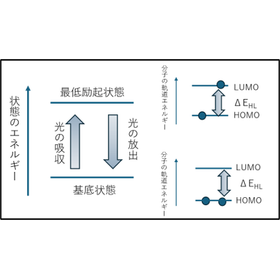
■ Electrons in the ground state gain energy from the wavelength of the light source to become excited, and during the process of returning to the ground state while losing energy, the wavelength energy emitted manifests as fluorescence.
■ This principle is related to frontier orbital theory (HOMO/LUMO), and it is considered that the absorption and emission energy and ΔEHL are approximately equal.
*For more details, please download the PDF or feel free to contact us.